Saturday, August 7, 2010

The Negative Aspects and Attitudes of Science versus Religion

God with scientific instruments as geometer
God the Geometer
Throughout history - with the exception of the Middle Ages - science and religion have been at odds with each other. While religion tended to lean toward refinement of the spirit and was rather engulfed in spiritual matters at the expense of earthly matters (I am considering most Western religions), science instead chose to accumulate knowledge and to form its theories based on physical bodies. Science preferred and valued events rooted in material evidence, observable facts that could be reproduced and replicated through controlled experiments.

Religion became more and more rule-based and dogmatic and thrived mainly on authority and hierarchy. In its negative forms, it developed a specific stance of mind, the “holier-than-thou” attitude. A priest because of his study, knowledge, experience, contact with the Almighty presupposes special abilities and the right to not only teach, but to actually preach. He considers himself as authorized to show and reveal to the rest of humanity the supposedly wrong and sinful paths and traps that we get lost and ensnared in.

Science, on the other hand, grew more and more confident, and to a certain extent it became too engulfed and self-absorbed in its deterministic factual ways. Science, again in its darkest moments, has become arrogant with a “know-it-all” attitude; supposed superficial superstitions are dismissed as mere child's play and fancy, yet at the same time, science overlooks the fact that it has become trapped in its own myth and superstitious force. Science in its rigid form is happy to limit itself to only those events seen and measured, but remains unresponsive to anything that defies its paradigm; it rejects and brushes off the invisible as nonexistent.

The ideal would be, as in most cases, a moderate approach, the middle way. There is a fine, yet distinguishable line between teaching and preaching, and, at the same time, nobody enjoys a patronizing voice. Render to religion what belongs to religion, and science to science. Both have made valuable and insightful contributions to the human condition; both are essential for life, and none can really exist or survive in isolation from the other.

Friday, July 23, 2010

Thanatos, Schadenfreude and the Self-destructive and Dark Side of the Mind

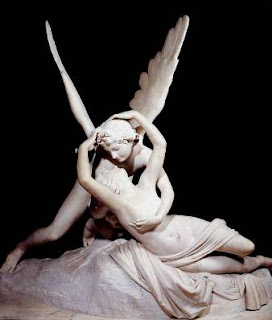
Eros and Thanatos in loving embrace
According to Freud, our life is played out in two different, opposing forces. One of them, Eros, is the drive for sex, love, and self-preservation, whereas the other is known as Thanatos, the drive for death and self-destruction. It is the yin and yang of motivations and urges. Put simply, Eros wants us to live and struggle through and with pain and suffering; Thanatos prefers to end it all with death, the equalizer, the dark force, the state of constant peace, calm, and rest.

There are many people who deny they have a dark side and deem themselves as thoroughly good. As a result, they often close up to all that could pose a threat to their (false) sense of security; they are paranoid about anything that might trigger “sinful” and “harmful” thoughts within them and strictly avoid sex, drugs and rock'n'roll.

Yet the dark side within is really part of human nature; we cannot deny its existence, nor fight against it through vicious attacks; all we can do is accept and embrace it, so it doesn't creep up and hide behind our thoughts and make us do horrendous things.

The healthy person does not ignore his or her dark side and tries to keep track of its movements by shining a large searchlight on the dark side's plans and motivations, so as not to be caught red-handed and unawares.

The line between sanity and insanity may be much thinner than we may suppose. Mostly, it may be carried out in the restricted area of our subconscious. The neurotic is obsessed with their thoughts and actions; the psychotic is losing - or has just lost - control of the flow of thoughts and actions, while the psychopath is spontaneously acting out violence and deriving pleasure from sadistic acts.

Schadenfreude, a milder expression of our dark nature, is a German term that best describes taking pleasure in other people's sufferings. Of course, it ranges in intensity and gravity, but the main idea behind this is the fact that the misfortune is funny and enjoyable because it is not happening to me.

We may not be the agent or cause of other people's suffering, yet we still take delight in it. This explains the popularity of shows like “America's Funniest Videos” where falls or hits in the groins are met with roaring laughter. In these cases, we are feeding our dark nature some snacks, an innocent-looking form of catharsis. We do not harm them, nor do we feel their pain, but we laugh at their mishaps gleefully.

Is Schadenfreude dangerous? It really depends. It may desensitize us to other people's sufferings. It should be kept in check obviously as most of us do not want to end up as sociopaths.

Yet at the same time, Schadenfreude can actually protect us from ourselves, mainly from Thanatos, the drive that wants us to destroy ourselves, the urge that makes you suddenly want to jump onto a moving train, for no specific reason whatsoever; it is the evil voice inside your head that is tempting you to gamble away all your money leaving you with nothing at all.

The voice becomes most adamant when things are going really well reminding us that we are all walking a thin, mortal line, while misfortune and death may be just around the bend.

In such cases, Freud proposes an effective remedy, one that is unfortunately not heeded enough in today's culture and society: Taking refuge in Art.

By producing many of these temptations in written, visual or musical form, these demons may give us a respite for a while. We experience a form of catharsis on a deeper level, much more potent than the temporary relief of Schadenfreude. And we come out of it a little lighter, a little happier, and a little more sane.

Sunday, July 11, 2010

World Cup 2010, Paul the Octopus, and Thoughts about Freedom and Determinism

Oracle Octopus Paul predicting World Cup soccer games

Every four years, people globally go crazy and fanatic about soccer, mixing with it patriotism, politics, and even historical knowledge. People who live in countries of economic turmoil, for example, hold on steadfastly to their team for a little hope; a winning team can re-inject the nationals with new-found or rediscovered pride in their country, or soccer can be used and manipulated by governments to procure or regain popularity.

It happens on the world stage; the world is watching and everyone remembers previous bouts and rivalries between the countries on the soccer field. Germany fans, for instance, found long-awaited justice for a goal that was not in Wembley in 1966 with the goal that was but remained uncredited in the 2010 match against England.

Soccer fans have good memory, and they go even further back, sometimes up to fifty years or so. Fifty years! We are talking about whole sets of new generations, not only on the field but also those watching the tube. Countries have changed over that time period, yet soccer seems to be fixed and eternal in the annals of history.

This time around, a strange sea creature got a lot of media attention since he is credited with an ability not of historical memory but of awareness of future events and outcomes. I am referring to the now renowned and famous Paul the Octopus, who has correctly predicted every game of the German team, regardless of win or loss, and has even risen to give global prognoses and predictions while bathing in media attention.

Now my issue is not with an octopus being psychic. I have no problem with mind-bending feats. I do think - do not ask me how or why - that it is possible and that it defies reason. In fact, if I had listened to his prognosis, I would not have lost 10 dollars on a bet of the semifinal match-up. I am more interested in the implications of the statement. What if it is true that you can predict every game. Would we actually need to have any more World Cups?

This may sound silly, but think about it. If indeed we can know for sure what will happen, should we still make an effort in what we already recognize as a losing cause? Should Germany try its best to beat Spain, even though it has been established that they would lose come what may? Do we have any freedom then? How hard should we try? Where are our limits? Is it all about participation, the German “Dabeisein ist alles”?

It is a question I have been fascinated with for a long time, and I am sure, without being psychic, that there will be other posts on the topic as well. But here I find it appropriate to mention this dilemma once again, the clash between personal freedom and determinism or even fatalism if you like. I subscribe to a certain brand of fatalism because I think, and science may support my cause with its karmic reliance on cause and effect relationships that, simply put, you reap what you sow.

Yet at the same time it seems you will reap, no matter if or what you sow because the outcome will occur anyhow, with or without your assistance. The only glimmer of hope might be this: Paul was wrong in predicting the Euro-Final in 2008. Was it error on his part? Or did the opposing team actually manage to create an upset, not only physically on the field, but an upset or hiccup of higher cosmic dimensions. No one knows what is really happening and only time can tell.