Friday, July 18, 2014

Why reason is undervalued and overrated


Tao sign on mosaic
  

It seems a strange paradox that reason is used constantly in our lives but at the same time it is not used enough. Many people pride themselves on their reasoning and analytical skills, but it takes a simple remark to throw them off kilter and make them burst into angry flames. Reason is put on a pedestal, be it the Age of Reason or scientific thinking, and yet people overlook what makes them fully human or spiritual beings.

To make things clear from the onset, I am a strong supporter of reason and think it is overall not practiced enough. In my daily life, I have to use analytical skills whether at work, for shopping or any other endeavor that entails decision-making or weighing the pros and cons of a situation. And so it should be.

Imagine if we did not control our behavior or temper it with the edge of reason. To begin with, we would blurt out what we think (honesty is a relatively good thing but purely impulsive behavior is not) to our colleagues, or mates or even people standing next to us on the bus. It is our reason showing us the possible consequences of our actions that makes us keep our corrosive emotions in check.

The fact is our emotions are based on a number of complex interactions and reactions, and we might accidentally say what we do not mean and spoil a relationship or opportunity because of it. Words then may become double-edged swords that cut both ways. In contrast, our reason is not as short-sighted, but sees things from a healthy distance and with composure.

If we were always led by emotions, we would go bankrupt since we would buy the first thing we see and would never be able to save up any money. It takes restraint and discipline fueled by the reach of reason not to fall into temptations (to which one could easily include those of sexual nature as well, which may exchange momentary pleasure for a life of regret).

Reason is also a useful tool in conflicts and communication. Generally, the person who has reason on their side is right and will prove the other person wrong. An argument or debate is won not by how loud you can shout or how much you can insult the other person but by the strength of the reasons presented. 

Nonetheless, it is frustrating when you are in the right, but the other person fails or refuses to see it that way and insists on their own perception or way of “thinking.” Those people seem blind and impervious to the words of reason.

Looking at modern society, we may notice a general lack of reason and even common sense. People believe in all sorts of wacky theories, (intelligent design being one of them), and such belief systems can eventually undermine progress for a society or country. Decisions will be made not on the basis of what is needed and best for the times, but rather on superstitions or erroneous beliefs. In this sense, reason is undervalued and underrepresented in current society.

But reason is also overrated. There are cases where people profess to reason and end up demonstrating worrisome behavior. It is interesting that apostles of reason can show you all the benefits and beauties of logical thinking and the next moment flare up in anger over insignificant issues. Even those who should know better will fall into the trap of irrational behavior.

If we look at scientists, they may be brilliant in their work, but there are many who also have irrational traits, such as vanity or even worse, narrow-minded views (sure nobody's perfect but they tend to believe their reasons and evidence make them superior). By not accepting flaws or (purposely?) overlooking crucial evidence to the contrary, even a scientist can become something of a bigot in certain circumstances.

For instance, I applaud that more and more renowned scientists have come out in support of alien existence, something that used to be a quack theory (though I am not so sure about alleged abductions). Scientists modest enough to accept that they are or may be in the wrong or that there is always room for doubt are true scientists in my books.

Indeed reason is not all there is. Even Descartes who was a strong proponent of reason did leave some gaps of reasonable doubt in his philosophy. In this way, I believe that reason is overrated because we expect reason with science as its outspoken collaborator to give us all the answers. In due time, this will happen, the reason supporters tell us. But it seems that reason in its narrow meaning is trying to forcefully edge out our emotions and spirituality, making us also bland and predictable. We then become indistinguishable from computing machines.

There are many decisions that should not rely on reason alone. Say, if you decide on a partner. You can weigh your pros and cons as much as you like, but if there is no chemistry, no emotional connection or attachment with the other person, this relationship, looking so good on paper, will fail in epic ways.

There are indeed moments and situations where analysis will stagnate us and where we simply need to listen to what is known as our intuition. Supporters of reason often mock or at least diminish the relevance of intuition. But my most successful decisions have come about because I followed wacky instincts of mine and made choices that would not cross the mind of a reasonable person. I have a number of “superstitious” beliefs that I have come to embrace despite and even against reason.

Perhaps reason is the grounding effect, the mooring of our thoughts and behaviors. But we also need to lift the anchor now and then if we want to move or find new shores. In other words, reason is undoubtedly beneficial but merely on its own it is rather limited. We need to balance things out and know when it is right to follow our analytical ways and when we ought to listen to those pesky feelings.

Sunday, June 22, 2014

Historical Perspectives and Hidden Truths: An Oliver Stone Talk at the Vancouver Biennale

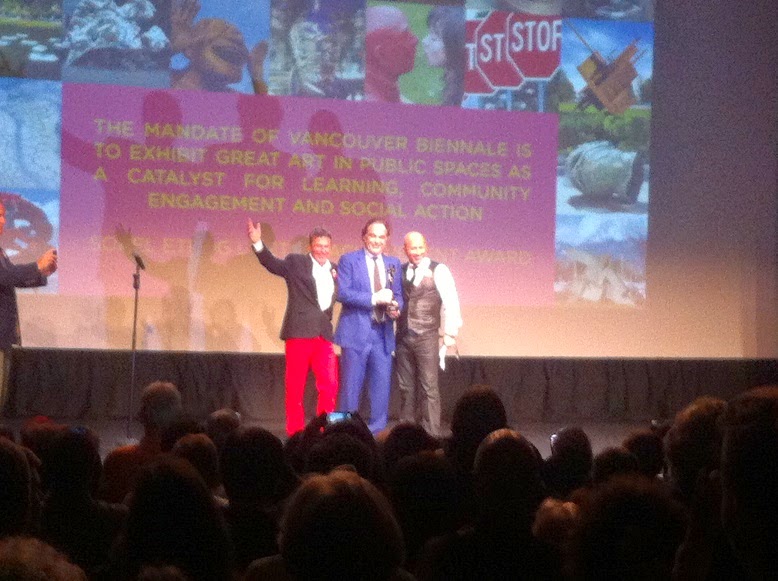
Oliver Stone receiving award in Vancouver talk


When I heard that Oliver Stone was coming to Vancouver, I was excited to see him. He was showcasing and promoting his latest work, a ten-part documentary series entitled The Untold History of the United States. Although I have not watched it yet (it has been on my watch list ever since it came out), I was curious to see what his views were on a number of topics, in particular current political events, and no better way to find out than to have him explain his ideas in person.

The event was organized by the Vancouver Biennale, a non-profit organization that has as its mission to immerse us with art in all its forms, from sculptures to the digital medium. Some of their work and sculptures displayed in the city are quite good, some of them not so, but as usual those matters are in the eyes of the beholder. Yet one thing is for sure, they do elicit a reaction from people, and in that sense, their art is wholly successful.

The evening of the talk was beset with some difficulties. I had to battle a migraine and general un-well being, while a block-and-a-half long line-up for ticket-holders did not help much to alleviate my pain. The music inside the theatre, a selection of Buena Vista Club confused me slightly in my legally drugged state and made me wonder if I had not erred on the date or venue.

Various minutes later than scheduled, we got a glimpse of Oliver Stone as he was given a lifetime achievement award, and it was needless to say (yet the presenter said it anyway) that everyone stood up and received him with applause. Oliver Stone said he would be back in a bit to discuss his show, and we got a screening of his final episode – but only after some bungling on the part of the organizers where they first could not locate the episode and then managed to play five minutes of the wrong episode.

Again the highlight of the evening was when Oliver Stone hit the stage with a moderator to discuss these weighty political matters. I must say that I am a bit skeptical of the choice for moderator since he seemed not to have the necessary skills to engage Stone in meaningful conversation. His questions and comments lacked spark and in moments like these, I imagine, in my arrogant mind, that I would have made a much better host up there had I been given a chance. Well, perhaps next time.

Anyhow, Oliver Stone explained his reason and motivation for this whole series as a desire to educate people on the selective lies that one is exposed to on a regular basis. In a way, this series might also be a culmination of all his previous political work, and since it has been fact-checked involving thousands of clips, it took much more time (and perhaps effort) than planned. Yet overall, despite the fact that it most likely was going to lose money (but the sponsors were rich to begin with in Stone's own words as his defense) it was mainly a labour of love.

Now last time Stone presented us with a labour of love, it was the much maligned Alexander (2004). During this talk, he referred to him once - the individual not the movie - claiming Alexander wanted to be a "citizen of the world." He was a conqueror who did not rape and pillage but let the inhabitants continue with their own religions and traditions, an open-minded attitude that generally eludes conquerors since they are either bringing - via force - religion (i.e. ideology) and / or democracy to the occupied people.

What was most remarkable throughout this talk was Stone's overall knowledge on the issues as well as his humour. At one point, he stated that the Civil War was a mistake and that they should have let the South simply go their own ways and look for an alliance up north with Canada. Coming from someone who used to be a conservative Republican in his youth, this is definitely controversial, apart from being humourous.

Yet Stone strongly believes in the importance of history to explain who and what we are today. History, he claims, gives us perspective. But the problem is that not unlike Orwell's 1984 we have people in power who change the facts of history and also offer us doublespeak to change our way of thinking and, at its worst, to brainwash us.

Stone did not spare anybody in politics. He called Truman as narrow-minded as someone like Bush and went into details how the New World Order is something that has had its deep roots in the neo-conservative thinking and outlook. Wallace, a rather easygoing but definitely more moral and caring alternative to Truman, was someone who would never have given the green light to the Bomb, but unfortunately the higher ups did not see eye to eye with him.

Ironically, at one point during the question period, Stone was confronted, not physically but with words, by a peace activist. Considering the supposedly abundant evidence that the September 11 attacks may have been an “insider job,” why did Stone lack or fail to mention this in his series? Did he lack the guts or was it merely an example of self-censorship when dealing with the establishment?

This was a key moment for me in his talk as I had waited for such a question and was curious to see the director's reaction. Stone was smart by evading the matter, but still giving it a certain weight. He said that it is possible that it was a conspiracy, but that was irrelevant in this matter since the outcome ended up being the same, the neo-cons taking full advantage of the situation to propagate their own beliefs and ideology. So in a way he neither said yes nor no. That way he keeps himself out of trouble either way, and we do not know what he really thinks about the matter.

The discussion did also touch upon Obama, whom Stone called smart and persuasive, but unfortunately, this president did not follow up on his words or keep his promises of change and hope. Obama continued with the same stands on the economy by giving incentives to the rich who had supported him during the elections. Stone said it was a pity because Obama should have simply run without any financial ties to major organizations and won on his own terms, which would have been possible considering how the Republicans had run the economy into the ground.

But another point was the issue of terrorism. This is something that has been hyped up constantly by the media making the US constantly alert and at the point of war. Obama needed to make sure that no such event happen under his watch so he had to agree to continued surveillance. Come to think of it, this was not something that posed such a significant threat as was played out in the media. For example, more people die from gun shots and traffic accidents than terror attacks, but the media is so good at inducing fear and distorting facts and realities.

One final interesting and enlightening bit I took away from his talk were his comments on Cuba and Russia. First off, Stone said that the US policy on Cuba including today is dumb and that Obama was kind of forced to go along with it because Florida is such an important swing state in elections, and he needs to constantly woo its citizens. Stone hopes that Cuba can be at least preserved as an “amusement park” a pristine place that has eluded the capitalism and logo-spattered surroundings that have taken over most of the world.

In terms of Russia, the issues are much more sophisticated than presented. The Ukraine incident is more complex than the media cares to portray. There have been deep-seated differences and conflicts there since World War II during which some of its citizens, in fact, supported the Germans. But also during World War II it was the Russians who shed the blood of millions of their people to win that war and the thanks they have received from the West has been negligible. In fact, the West turned on them right after and proclaimed them as the "evil communists" with whom they would be at war for decades to come. Then when Gorbachev wanted to reform the Communist system, he was met with resistance from the West, which preferred Communist annihilation.

All in all, one should at least listen and take in what Stone is telling us regardless of one's own ideology or beliefs. He offers an alternative view on historical as well as current events. At best, he may be right, and we need to come up with a world that is based on truths instead of accepted lies. Stone does not say that all our history is wrong, but that we are presented with the Disney version without the blemishes and the stains. The US needs to take a good look at itself in the mirror to accept its previous mistakes and make good on them for the future.

At worst, he may be wrong, be controversial for controversy's sake; simply someone who is stirring the pot for no particular reason. Even so, one has not lost anything by listening to what he has to say and to feel free to dismiss his points of view. I personally stand more on the first side because as a superpower the US has also great responsibilities. There are many instances where personal profit and gains have overridden human rights and freedom. Considering that the US started as such a free and democratic country dropping the yoke of serfdom from the British, it is rather a shame that they are becoming imperialist themselves and not fulfilling on those promises and hopes that once rested on the shoulders of this glorious nation. 
 

Sunday, June 8, 2014

Circus in Cinema: The Metaphor for Life


Street circus performer

Recently, I had two consecutive brushes with the circus world. The first one occurred while watching and reflecting upon the Italian Oscar-winning film The Great Beauty (La grande bellezza) (2013). The movie's first ten minutes or so are confounding until the film settles into something of a bare-boned somewhat cohesive story. The film's main inspiration is undeniably the works of Fellini, and both La Dolce Vita (1960) and his masterpiece 8 1/2 (1963) are evoked and alluded to, if not shamelessly copied from.

In fact, most of Fellini's work uses the circus as its ideological inspiration. His movies are peopled with a number of odd creatures or freaks that are fodder for absurd situations and outcomes. The circus deals not only with the odd and bizarre, but also has its own brand of awe and magic. 

It comes as no surprise that in both 8 1/2 and The Great Beauty we encounter magicians. In the former, the enigmatic magician has telepathic powers and, although blindfolded, knows the purses' contents of audience members. In the latter, the magician manages to make a giraffe disappear in front of the protagonist's eyes.

In both cases, the magicians admit that it is all an illusion or a sham. However, the visible result manages to be still perplexing and affecting. This could be interpreted as a metaphor for cinema and movies in general. The director is the one who plans and creates these vivid illusions, which are a skillful combination and weaving of images, music, and words.

And it is us the awestruck viewers who take in the magic presented on the screen. The most vivid example would be one of the first instances of cinema when people saw a train coming towards them, and they moved and ducked in fear. Or the fact that movies can evoke a whole gamut of emotions and scare us, make us cry or laugh. Yet in movies that take their inspiration from the circus, anything goes and anything can happen, and we are invited to think outside of the box of our ordinary existence and see the world with the curious yet unquestioningly accepting eyes of a child.

Incidentally, one of my all-time favorite films, Wings of Desire (Himmel über Berlin)(1987) has an angel fall in love with a trapeze artist. In fact, during a circus performance, one of the kids addresses the angel quietly seated there. To the dulled eyes of the adults, the angels are not visible, and Wings of Desire underscores the theme of beauty and wonder perceived and seen only by the eyes of the child through the beautiful poem “Song of Childhood” by Peter Handke. In the eyes of the child “everything was soulful and, and all souls were one.”

Children become important in these movies. They seem to know the answers or at least they have the correct outlook or philosophy on life; this somehow alludes the adults because they have forgotten all about it. We are so clouded and burdened by the weight of reason that we cannot see the marvel of existence, the very circus occurring in front of our eyes.

Yet the circus is no stranger to cinema. Movies have embraced the circus as a symbol since its heyday; the circus had its own birth or marriage since Chaplin, and it finds its own updated and rejuvenated voice and vision with the continuous works of Baz Luhrmann and its not so distant cousin, the surreal film that characterizes David Lynch's or Terry Gilliam's work, for instance.

The day after seeing The Great Beauty, I actually attended, for the first time, Cirque du Soleil's Totem show. It was not a deliberate succession of choices, that is to have the movie follow by an actual act, but it was enlightening to have the circus represented in its actual “live” and living form. It has been a good number of years since I had been to the circus myself, and it was so much more impressive this time around not only because of the tremendous show, but also due to the fact that my son was watching it with me.

And his jaw was open most of the time. It was out of sight to have these performers suddenly take flight and hover over the stage. There was an awe I had not felt in quite some time, and it was also reinforced by looking at my son's unfettered reactions. Although no live animals were used as the circus of my past - for better or for worse – was wont to do, there were still those essential components of any circus, namely the clowns.

One of Fellini's later movies had that same title, The Clowns (1970). Chaplin's Limelight (1952) showed us a sad clown, one that may still have had love and passion for his art, but felt that others had seemingly outgrown those simple but lasting pleasures. In fact, all these works that are aligned with the circus have dashes of humor. The circus represents not only the extraordinary, but it also stands for joy and laughter.

No scene sums that up better than the final sequence of 8 1/2 in which a tortured Guido finds solace in directing and orchestrating an impromptu circus parade. The underlying message of these films might be a heart-felt invitation to see the circus as a metaphor for life. There is joy that we do not see or perceive because our mind forgets that life is not only a stage on which we act as Shakespeare once observed, but that it is in fact a full-blown circus filled with clowns, acrobats, and yes freaks.