Wednesday, March 30, 2011

The Legacy of Ed Wood or the Director that Simply Couldn't


Ed Wood in promo shot of his movie "Glen or Glenda"
Ed Wood
Golden Turkey Award Recipient Ed Wood is both inspiration and comfort for aspiring directors and artists out there. He gives each of us hope that it is possible to do what you like, to make movies and create art. At the same time, he is relentlessly persevering, despite the fact that he lacks talent and vision. But who cares, follow your passion to the ends of the world and let the chips fall where they may.

Most of us who, all modesty aside, may be more talented than Ed Wood become roadkill on the road to success. After receiving rejection after rejection, even our thick skin becomes eventually pierced. We give up, take up another profession to pay the bills. We sacrifice our teenage dreams because of the reality of life. Being an artist takes more than courage, hard work and dedication; it takes endless perseverance and an insane amount of luck.

In the case of Ed Wood, he was so thrilled and passionate about making movies that he basically forgot about all the rest. The financial part is always a pain in the neck when it comes to film-making, but if you are crazy enough about your projects you will do whatever it takes. Rumor has it that Barbet Schroeder threatened with cutting off his fingers if he did not get his directorial stint of “Barfly,” a movie about another artist, Charles Bukowski, who went to extremes to live out in flesh and blood his poetry and fiction. It seems my life is too tame, “sane” and inane to make me eligible for the category of bleeding heart artist.

Notwithstanding, Ed Wood is also a source of comfort for us. He was by any standard a mediocre artist. His writing is often cited as jewels of bad lines, such as, the following quote from Plan 9 from Outer Space: “Earth people, who can think, are so frightened by those who cannot — the dead.” It is true that it takes talent to write bad lines like those and not everybody can do it, but it came naturally to him. 

At the same time, his directing skills were less than apt, not to mention his attempts at acting. He compares himself to Orson Welles who preferred to write, act, produce and direct his own movies, in other words, to have absolute control over his work; yet it is evident that the two are the apples and oranges of comparison.

Although I may be too harsh on poor Ed Wood, it is not only him I am targeting. He is just a random victim I have chosen for my own purposes here. He is the incarnation of the tragicomic artist who brims over with enthusiasm but seriously lacks talent. He is the one who is courageous enough to stand up despite the adversity of critics and the public and do his own thing. He is the M. Night Shyamalan who, Sixth Sense excepted, somehow manages to survive disaster after disaster; not even Titanic failures can diminish their love for the arts.

And when it comes down to it, who can really stop them. These guys will find funding, even if they have to scrap up money from the streets, work as a dishwasher in restaurants, or even get baptized. They truly inspire me, not for their work, but for their unfailing confidence in themselves. And I prefer them with their blind faith and passion over all those artists who work for commercial reasons only and do not see art as an expression of life, who do not breathe and sweat art, but regard it as another job that brings in a paycheck at the end of the day.

Friday, March 25, 2011

Giving St. Paul a Chance and his Influence on Christianity


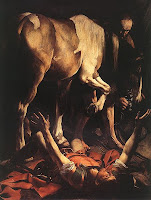
Saint Paul falling off his horse in Caravaggio painting
The Conversion on the Way to Damascus
 by Caravaggio

I have for some reason or another always had preconceived, mostly negative, notions when it comes to the legacy of St. Paul. Despite his invaluable contributions to Christianity, I have objected to many of his views, methods and even his personality. So I decided to look into the matter and give St. Paul a chance by investigating him, myself and everything in-between to reach a more balanced and hopefully more open-minded perspective.

The Personality of St. Paul

As a matter of fact, Paul the Apostle appears to have bipolar tendencies, since he moves from humility to grandeur, from being a servant to an equal of the Lord within instants. St. Paul embodies indeed striking contradictions. He was a persecutor of Christians turned into a persecuting Christian in a flash. He turned famously from Saul to Paul when he was blinded by the lightning flash of Christ's truth and fell off his ass, i.e. donkey.

He was also somebody who was eloquent in writing but supposedly miserable in public speaking. Yet it cannot be denied that after his miracle-like conversion, he was passionate and fully dedicated and convinced of his noble cause and that nothing could stop him. Apart from his courage, he was at an advantageous position, being not only of Jewish origin, but at the same time a Roman citizen fluent in Hebrew, Greek, and Aramaic. As such, he could reach a variety of people during his numerous trips.

One of his greatest contributions has been the fact that he managed to open up a Jewish religion to include and embrace Gentiles as well; in other words, to turn a specialized religion into a universal one. The humanity of the teachings of Jesus interpreted and filtered through this saint's vast knowledge became hence appealing to the masses and spread like wildfire inciting and inspiring millions as a result.


On Original Sin and the Problem of Evil

One of my “thorns” with Christian doctrine has been the problem of “Original Sin.” According to this belief, Adam committed a grave sin by eating of the “forbidden fruit,” blemishing and cursing all of subsequent humanity with his deed.

In the ancient past, it was a commonly accepted belief that one's sins will be spread over and transferred to future generations, so that the sins of the father equal the sins of the son. In ancient Greece, for example, shame that was brought upon a family was not that easily erased but remained for various decades and stained the family name.

Today, with our firmly established concepts of individuality and responsibility for one's acts, it seems rather unfair that one person's wrongdoing should reflect to another just because of blood ties. We are not guilty of other people's sins, no matter how close they may be to us. Much less, when the sin is committed by someone eons ago in an undefined place far far away with whom we have very little in common except in an abstract form. And well, all Adam did was eat some fruit. Big deal.

But I think the view of St. Paul on the matter becomes a little clearer when we replace the overcharged and problematic term of sin with evil. What Adam did was wrong not because of its act, but because he disobeyed God's orders. This would mean that he may have acted not out of curiosity, but out of vanity or rebellious pride. His act then could be interpreted as one of open defiance with an underlying evil motivation.

As a result, this attitude may have remained with humanity; it is genetic. The evil -- or estrangement from God and the good – that is passed on is that dark unconscious that each of us carry inside from generation to generation. It is that force that made Cain commit the first murder of history by killing his own flesh and blood Abel. It is that which estranges us from our fellow being and leads to war and destruction. That such dark forces dwell in humans is not illogical considering the horrendous deeds of our history continuing into the future.


On Sex and Women

My other objection has been his treatment of sex and his view on women. St. Paul may be in large part responsible for turning sex from a pleasurable activity to a sinful and shameful act. His ideal persons were those who fought against the prickly thorns of desire, did not sleep with any woman (or man?) and who became fully engulfed in their divine mission of preaching the gospels. It seems then that the best one can do was to become a monk and live a cloistered life. For those who were “weak,” they could marry and have children, but they should still control their sexual appetite and not fall prey to the fleshy entanglements of lust.

At the same time, he along with his spiritual brother St. Augustine, fought hard with his own sexual demons. Since the two saints were so immersed in their own struggle, they saw women as temptation and the supposed cause and constant possibility of any saint's downfall. They were not unlike recovering drug addicts who cannot bear the sight of drugs in case of a relapse.

Yet unfortunately, and undeservedly of course, women had to take the fall. They turned into instigators of sin, hence evil. The charming and beautiful Eve was suddenly the main reason why Adam behaved the way he did. In its extreme, it may lead to the ridiculous assumption that the world would be a more tranquil place without women.

Again, I will try to give St. Paul the benefit of the doubt. At other times, he claimed that both men and women were equally endowed for spiritual greatness. His views on women being "inferior" in society, the wife serving the husband and the husband taking care of the wife may be rather a reflection of the times. We must not forget that St. Paul was living in a pre-feminist era that did not consider women equal to men, while Genesis with its insistence on woman being created as man's playmate out of his ribs did not help in this matter.


Above the Mosaic Law and Being in Direct Contact with God

St. Paul rejected the traditional observance of rites and rituals, generally known as the Mosaic Law or the Torah and replaced it with the idea of a more direct contact and interaction with God, through faith. He built on ideas, such as love and forgiveness that had surged mainly with the advent of Jesus, and these ideas along with the issue of faith had a direct influence on St. Augustine, Martin Luther and the later Protestant movements.

In fact, St. Paul was not so much interested in the life and teachings of Christ, but rather in the fact that he was the Messiah. And the token of proof of his Messiah-ship was the Crucifixion and the subsequent resuscitation and ascension to the heavens to be at God's right side. Christ's resurrection was purported to be seen by a handful of people, including himself and the Apostles, but for the rest of humanity, it was to be taken on the article of faith.

Faith in the unbelievable became then an important aspect and cornerstone of Christianity. It was the unwavering belief said to redeem all of humanity regardless of status and position. Since faith knows no boundaries, it had an equalizing and democratic influence and made Christianity, at least in theory, accessible and appealing to anyone, whether slave or master, uneducated or learned.

Because of his teachings, St. Paul came into conflict with the authorities, making him a revolutionary in their eyes. His ideas were deemed controversial, and he had to spend time in prison. As he was completely dedicated to his ideas and causes, he eventually ended up dying a martyr for what he professed to be the truth.

As can be seen, I have tried for some reason, God knows why, to defend the case of St. Paul although I have only scratched the surface. After reflecting on his struggles, accomplishments and legacy, I find a certain type of admiration for him. He was like any person or saint, not without flaws. Yet at the same time, it makes him more human and a little more accessible to us. We may understand his motivations and his beliefs, while retaining the right to disagree with certain aspects of his teachings. Yet his decisive influence on Western thinking and on Christianity itself is beyond doubt.

Saturday, March 19, 2011

Writer's Block and the Artistic Nightmare of Having Nothing to Say


Poster with Marcello Mastroianni of Fellini's movie "8 1/2" on writer's block
There is a wonderful dream sequence in Fellini's 8 1/2 in which the inspiration-troubled director Guido has to face a multitude of questions and comments by obnoxious journalists hungry for news and information about his latest, abandoned film project. Guido cannot take the pressure anymore and seeks refuge under the table. There is a close-up of a mad woman with a diabolical laugh who shouts in English the sarcastic words that are deeply piercing to any self-respecting artist in the world: “He has nothing to say.”

First off, writer's block is a serious condition. It is the mental equivalent of having a leg cramp. Sometimes worse, it is a broken leg. The same way, your employer cannot expect you to go to work in such a condition, you won't be able to get writing done when afflicted with this serious ailment. It basically feels like you are drowning in a wide open ocean and find nothing, no floating wood, not even a straw to hold onto. It is every writer's nightmare, and each of us will have it as regularly as the seasonal flu.

But there is a deeper problem, and this may secretly nag in the entrails of any artist with serious literary or artistic aims and ambitions. It may pop up at unexpected times: Am I original? Or, to put in a more direct and harsher way: Am I relevant?

They say that everything has already been said. Nothing can be truly original anymore. Ideas have been out there since Plato and have found expression; you may think you have come up with it, but guess what, somebody has already beaten you to it. This may also explain the feeling of paranoia in some writers who guard and shield their work as if it were a religious relic. Ideas can be truly valuable and may be stolen the same way a thief robs you of money.

It is also why many writers may fear the Internet for those reasons. The Internet is growing at the speed of light. There are literally millions upon millions of blogs and articles swarming through cyberspace. Whatever I may blog about has been done a million of times before, and it is all accessible at a simple click of the mouse. It is equally exhilarating and frightening.

The Internet is also where thieves and hackers roam. They prey upon what you do, steal your ideas, sometimes even your identity. They present your ideas as their own. They maybe even sell it and make a profit, while you are struggling on a day-to-day basis as a starving writer. All this is not fair, not only because they are using someone else's work, but because they have not experienced the labor and pain associated with creation, the sleepless days and nights and the deeply disturbing impotent feeling of writer's block.

Apart from all those concerns and ideas and the competition writers experience with one another, we give ourselves an occasional hard look in the mirror and ask ourselves whether we have what it takes. Blogs are truly artistic and non-commercial in the sense that you are your own boss, that you do not have to follow an editor's or publisher's guidelines, but at the same time, you become fully responsible for your material. It also brings with it anguish and feelings of insecurity. Is it good enough? And will people actually read my blog? What do you think?

Personally, I find it very difficult to know which of my articles will “succeed.” By success, I mean popularity. There have been so many “surprises” that it becomes confusing at times. Sometimes I think I have written a pretty decent article, only to find out that it has only one or two views per month. Others that have barely made the “cut” get a rush of visitors. It is often hard to be objective and accurately judge how good or relevant your own personal piece of work is and what impact it may have.

Perhaps it comes down to the following two viewpoints. One, write what you are truly passionate about, something that resonates within you, that you find deep and meaningful and want to share with others. Two, you will have to deal with the fact that, like Sartre claims, you are the object reflected in other people's eyes. That's what being a social animal entails. People will raise you to the heavens or rip you apart, or even raise you to heavens to rip you apart. They will make you believe you are a true artist or will let you know in unequivocal words or shrill diabolical laughter underlining their superiority and control over you: “He has nothing to say.”