Tuesday, June 21, 2022

Mana, the Tree of Knowledge, and the Fall from Eden

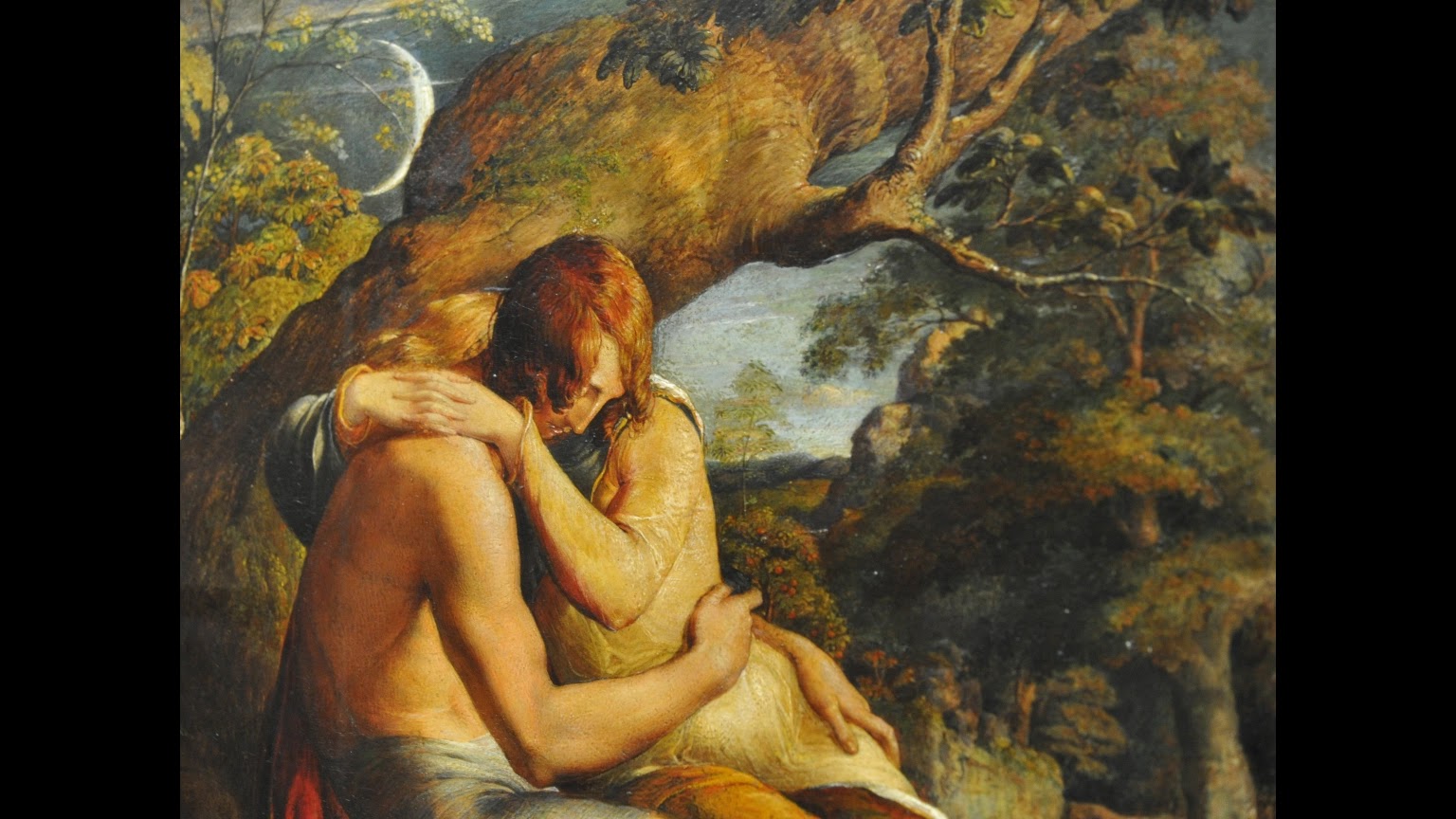
Adam and Eve hugging each other
For a long time, the Story of Adam and Eve hand in hand with the advent of original sin and the subsequent Fall from Grace has been of great interest to me. In fact, I am not the only one who is puzzled/slightly obsessed with the Fall from Eden, nor is it limited to religious and philosophical discussions: various psychiatrists have tried to wrap their heads around this phenomenon, the alleged origin of humanity, and human sin. I have already expounded on different views and interpretations here, apart from my own thoughts and reflections, which, by the way, keep changing and are being modified as we speak or as I continue to read fascinating insights and theories on the topic.  

I certainly enjoyed Erich Fromm’s discussion but that was before reading Otto Rank’s brief mention of Adam and Eve in his outstanding if at times confusing, confounding, and baffling book Psychology and the Soul. Fromm’s depiction of God as not-(already)-perfect but as always striving for perfection, a dynamic and constantly evolving being that is not fully shaped and formed was thought-provoking, to say the least. In that sense, God operates on a higher spiritual plateau, which is, in fact, not an endpoint in and of itself but rather a path that continues and evolves towards growth and fulfillment.

This view raises and opens up some interesting questions and observations for me especially after reading Rank. It could represent a potential shift or rift from monotheism to henotheism and would come closer to a gnostic reading of the Bible, in particular concerning the passages of Genesis. The assumption would be since God is not perfect, he may also feel threatened by other potentially superior or at least equally capable and competitive supernatural beings. In a sense, God would play and adopt the role of an impostor and would prefer to keep his creation unaware of this and make them believe that he is indeed the sole creator and ruler of the universe.

And that brings us to the tree of knowledge. My question is why would you put and build a potential source of temptation and conflict into your own garden? The idea that it is simply a test is rather naïve. And if it were so, why did God get angry and overreact? As an instructor, I know what it feels like when students fail to perform on the level that they are capable of, and worse if they cheat on exams. But it does not and should not amount to nor emanate in wrath and ire and dire punishment!

But what if God needed the tree for himself? This is where the idea of mana can come in, the divine food/fruit that is imbued with special powers. Mana is a spiritual life force or energy; in other words, it gives you power. It is essentially neutral so this power may be used for good or for bad. Some people are born with it, but it can also be cultivated, augmented, or transmitted.

In ancient Hawaii and in Tahitian culture, there are two opposing gods that thrive on mana: the god of peace and fertility represented by Lono and the god of war and politics symbolized by Ku. Regardless of their divine status, regular humans can gain mana through right, noble and altruistic actions generally referred to as pono. But one can also increase mana through the act of prayers and through the aid, help, and assistance of spirits, be they of ancestral or divine nature.

In fact, the concept of mana is not unheard of and has been designated in different shapes and forms by various cultures and religions. Basically, it has similarities with chi, the Chinese life force and it is also affiliated with mojo and Freud’s libido. It is interesting that this life energy and force can easily be connected to the sexual drive and sexuality in general, which is not only life-giving but also life-affirming. And yet, it is important to note that the story of Adam and Eve is not about sexual sin but rather a case of disobedience.

Now let us look more concretely at Adam and Eve. The tree of knowledge was not used as bait or temptation, but it was much more practical than that: it may have been a precious source of spiritual nourishment for God himself. Although the serpent is blamed for enticing Eve to later convince and persuade Adam, the situation and circumstances may have been slightly different.

In the beginning, there may have only been Eve (Heva), who was associated with the Phoenician serpent goddess of the underworld and the mother of all living beings. Moreover, as Rank points out, she was the primal representative of the primal mothers, that is Earth, the mother goddess. In a sense then, it is Eve who gives birth to Adam, not unlike the Virgin Mary bearing the (other) Son of Man.

At the onset, Adam meaning “red” and most likely related to red clay or ground, did not have a name. But his name may have been the feminine form “adamah” meaning “moist earth” and from which he himself was formed. In that sense, neither Adam nor Eve would be motherless; the latter an emanation of the earth goddess, and the former then becomes earth and flesh destined to till and cultivate the land. (Technically, Eve would be his divine mother-creator as she has not physically given birth to him; hence, their sexual union would represent at least only ideologically an incestuous relationship.)

According to this interpretation, the serpent and Eve have fused into one. They convince Adam to set on his quest for knowledge, which is in this case, the tree of the forbidden mana. Once he partakes of it, he wakes up from his ignorant bliss and moral torpor and essentially starts the quest for immortality; in the process, he becomes willy-nilly a rival to God who is clearly and perhaps justifiably angered with as well as afraid of this outcome.

So God ensures his own safety and predominance by banishing and banning them both as personas non grata; they would never be allowed to enter or set foot in his realm again. Interestingly, when we say God has created mankind in his own image, from a psychoanalytic perspective, it makes more sense to claim that humanity ends up creating God in their image. And in this way, the divine would become an anthropomorphic projection of humanity’s wishes and desires for omnipotence and even more importantly, immortality.

It is this same desire that is a threat to God and paradise, and it is not as is generally believed a matter of sexual temptation and its subsequent activities and outcomes. Seen from the divine perspective, it is not only a case of disobedience but rather defiance of established rules, orders, and authorities.

Seen in its negative form, it is hubris that can lead to the demise of this carefully constructed creation. The sexual act is equally rebellious as it can ensue from and out of sexual desire, mana-turned-mojo that is activating and charging the libido. But more importantly, it is the life-giving aspect that is of relevance here: with this procreational impulse (as in pro-creation), it is creation that is carried forward and intergenerationally immortalized across many generations.

Ironically, if Adam and Eve indeed had immortality, to begin with, they lost it by seeking it. This may be the doom and saving grace of humanity. Our quest for immortality combined with the fear of death and annihilation keeps driving and propelling us forward in various ways and forms. It is mana-in-action, and without it, we might as well be dead. Genesis represents the birth of humanity, and it started off in its infancy with ignorance and, at the same time, in a state of undifferentiated quasi-mystical identification with the divine.

But we then moved from this state of ignorance to one of knowledge and consciousness and with it and out of it comes the creation, individuation, and differentiation of the self and others. Yet, it remains in our own hands, how we morally use this energy and life force, whether for good or for bad, for growth or for destruction, and this is essentially where free will comes into play, the very soul and essence of who and what each one of us essentially and truly is. 

Monday, May 23, 2022

Infantile Amnesia, Trauma and the Recontextualization of Broad and Generalized Anxiety and PTSD


Dr. Lynn Nadel at UBC answering a question
After a hiatus of more than a couple of years - yes, you guessed it: due to the pandemic - it was finally back to (relative) normal for me with a long-overdue (masked) in-person attendance of one of my favorite traditions of psychology, the annual Quinn Memorial Lecture! This year’s talk was about memory, and it was presented by Dr. Lynn Nadel from the University of Arizona entitled “Brain Development and the Emergence of Learning and Memory in Humans and Other Animals.” And yes, humans are animals, hence the deliberate use of the word “other.”

Getting out and getting to the location was more challenging than expected. It was one of my first large-group outings since the onset of the pandemic, and I was slightly nervous. It did not help much to encounter continuous construction sites and the rerouting of traffic due to construction and closures. It was with some difficulty I managed to get to the university site and with UBC’s mandatory masking rules in place for another month, this year’s lecture was in equal measure familiar and unfamiliar. 

But the main thing was that I was finally able to be there in person and ready to take in another interesting and insightful lecture with the added bonus of a complimentary glass of (red) wine and psychological chit-chat during the subsequent reception.

The lecture started with an interesting tidbit of trivia that was new to me: hippocampus actually means “seahorse" due to the similarity in terms of its shape, and, for better or for worse, it has nothing to do with hippos. The other bit of surprising information was that the hippocampus does not develop for the first two years of life - its function emerges only after 18 to 24 months with its fully adult function from 10 to 12 years - which explains not only pre-adolescent forgetfulness but also why we cannot remember anything from our first few years of infancy, and which also implies that those who claim they do are either misguided, misled or they are simply lying to you.

I was pleased to hear Freud’s name mentioned during the lecture, but sadly, it was not done with the sufficient respect I had hoped for. And yet, there were three reasons given by the father of psychoanalysis, and all of them contain at least a ring if not a shout of truth to them. Freud hypothesized three potential reasons for the dead zone of infantile amnesia, namely that it could be because of repression (a plausibility but not applicable to all cases and situations), the second reason was the non-translatability of experiences due to an absence of and recourse to language, and finally, that it may have been due to biological development and mechanisms.

We now know that the last two are certainly of importance here. We should not forget that Freud himself was a neurologist and to be able to see things clearly in a time and age where neuroscience was in its own infancy is truly impressive. It is evident now that the hippocampus develops and matures later than various other parts of the brain and that language and self-consciousness and self-awareness do not make an impact until after the second year of life. Adding to this, it is not just a matter of being unable to form episode memories but memory, as a rule, and as a function, is not meant to capture events photographically but rather to be used as a tool for predicting future events and essentially setting up conditions and opportunities for overall learning. 

This also has serious ramifications for the experience of stress and traumatic experiences in the first fragile and impressionable years of human life. Any neglect and trauma become stored not as a concrete memory but as waves of vague, uneasy, and seemingly impenetrable feelings. This is different from the usual and regular issues and matters that the unconscious is tasked to deal with because the experiences have not been formed and are shapeless in this case.

The unconscious is the convenient and useful placeholder for and reservoir of unwanted memories, feelings, desires, wishes, and traumatic experiences. Although they seem to be locked away, the contents often leak and seep through and may create a number of neuroses, neurotic afflictions, and anxiety. But in his lecture, Dr. Nadel was claiming that our fears and anxieties may usually have a traceable cause, such as fear of dogs resulting and emanating from a memory of a dog bite in childhood. But the problem is what if we cannot find or trace our fears, phobias, and anxieties back to any specific event? For instance, what would cause the prevalent fear of spiders even though the person in question may have never had any negative contact or experience with those insects?

Of course, we could refer to Jung’s collective unconscious and that there are archetypical fears that regardless of personal experience, we collectively inherit and operate within. But another possible explanation could be that we might have had a negative experience say of a bite but since it occurred at a time where we did not have access to a) any memory - remember we are still lacking that capacity before the age of 2 - and in addition to having no access or recourse to b) the benefits and clarity of language.

When we experience fear-inducing moments with a clear and distinct sense of threat, a road accident, burglary, or attack by an animal, we do not need language to tell us what to do, but we instinctively and automatically engage in fight, flight, or freeze behaviors. But what if it is something that is at least from a rational perspective a non-threatening and often benign-seeming situation? We understand how the sight of dogs can be fear-inducing for some but few of us would feel that way about puppies. So how to make sense of that kind of seemingly irrational fear?

In this case, we sense not only concrete, specific, plausible, and traceable triggering experiences of fear but also the vague, broad, and generalized forms of anxiety in which threats are sensed and perceived where none of them seem to exist except in our own perception and minds.

This may be due to traumatic experiences at a point in time where we were either too young to process them or too overwhelmed by them. Infants may internalize the dread alongside feelings of fear and since they have no context nor nothing to compare it with and have nothing to express nor make sense of it, it remains floating and elusive as a general sense of ominous and foreboding threat. This could lead to panic attacks and the fear of open spaces, with agoraphobia being a less common form of fear as opposed to claustrophobia and the fear of spiders and heights, which many of us commonly experience. 

This would be then due to the amygdala being switched on without the mediation and aid of the hippocampus in the form of stored memory as well as a lack of rational thinking via language and logic in the prefrontal cortex. And yet, the feeling of unease might get imprinted and recorded across various parts of the brain and hand in hand with sensations stored in the body. In an experiment where rats were stressed early on (poor things), the effects of early environmental stress could be demonstrated as well as how the hippocampus is loaded with stress receptors and how stress affects and weakens the development of the hippocampus. 

In fact, a similar process may occur even with adults who experience significant stress and trauma. The clearest example in history would be when perfectly healthy adults came back from World War I and were shell-shocked, i.e., simply not being able to shake off, process and digest their feelings of fear and dread and making it difficult for them to function in daily life. Those “shell-shocked” individuals did not have any issues or precursors with mental health, and we know now that they were suffering from post-traumatic stress disorder (PTSD).

When seemingly random events trigger those events (and it may not even have a trigger or provocation, to begin with), the afflicted person is not simply remembering what happened to them, but they are reliving the whole stressful and traumatizing experience repeatedly. It is not a case of episodic memory, but it seems that they are not able to recall it without the mental anguish and debilitating bodily sensations that are intimately linked and associated with the original experience.

This is often due to stress downregulating the hippocampus, which would usually give it a label and a context, and increasing the amygdala, which is connected with sensations of fear. In other words, the reactions to threats are isolated and taken out of any and all context, and this enhances emotional memory in the amygdala. The hippocampus is further weakened and affected due to exposure to too much cortisol.

As a potential form of treatment, people suffering from this condition could be encouraged, helped, and guided to contextualize and in some cases even re-contextualize those experiences, that is to give them a definite form and shape and then be able to store them properly in memory and be able to understand and process them more effectively. Evidently, this boils down not just to a matter of reason and rational thinking, but it can help to understand it and to put it into context; then, one can gradually deal with the emotional aspects and counterparts without being overwhelmed by those paralyzing feelings of dread and fear.

As you can see, this year’s Quinn Memorial Lecture was another wonderful opportunity to learn more about the brain and psychological processes and where I was once again able to mix and mingle with like-minded and interesting people. It was indeed a most memorable lecture!

Tuesday, April 26, 2022

Another Personal Letter to the Almighty

Dear Almighty,

It has been various years since I last communicated an open letter to you, which means that either things have been going so well and smoothly that I have not had the will, need, desire, or time to ask you for a favor or that they have been going so badly that I have not had the will, strength, and desire to write to you. But, in fact, it is more a case of a bit of both.

After I last communicated with my expression of gratitude, things began going up and down in a somewhat reasonable manner. There was a specific time of deep low though, and it put me on a slightly different quest, namely one in which I learned to manage and cope with my stress and anxiety. It was triggered by an unfortunate outside event, which ended up making and causing mighty waves with immense repercussions on the inside.

In fact, it made me realize something: We are all walking time bombs of some sort. We absorb and accumulate certain amounts of stress, pain, aggression, and suffering and often with very little awareness and acknowledgment of this happing and developing deep inside of us. And then, something happens that switches it all on, flares it up and puts it on overdrive. Suddenly, we feel overwhelmed, and we tend to call and label it burnout.

But the fire had started long before the stress-inducing event and may or may not be directly related to the incident. Up to that decisive moment, I was not aware that I had been living under chronic stress for various years. I had been distracting myself with matters that did not matter and was afraid to face my proverbial inner demons.  

They came in all shapes, forms, and sizes, but their common denominator was negativity in all its varyingly toxic emanations and expressions, such as worry, fear, anger, doubt, distraction, escape, and what-have-you. Back then, I was not familiar with the world of hamsters, but it was like always running on the wheel with apparently never enough time for anything. It was Sisyphus not knowing or not wanting to realize that he was condemned to roll the rock up the hill. It was all work and no play with me never stopping to inhale a mouthful of fresh and vibrant air, let alone to stop and smell the roses.

And yet, I noticed something was amiss and started taking concrete action towards fixing and repairing my malaise. I was never truly unhappy but was also never fully happy nor satisfied but I knew I did not want to continue that path. As a result, I made plans and intentions to rectify this mild to moderate depression of sorts. So, on New Year’s Eve of 2019 (and without access to 20/20 hindsight), all dressed up with a few achievable goals in mind, and goodwill and hope aplenty, I clicked my glass of sparkling wine with my wife and told her and my son with an enthusiastic and excited voice that 2020 would be a good year for all of us and a year of substantial and significant change!

And then, everything changed. Everything was abruptly put on hold while various plans dissolved into thin air. But the seed had been planted, and more than ever, I was inspired to get well and better. As I managed to face and calm those inner demons driving me and to appreciate and value the slings of misfortunes I had encountered along the way, as I was able to stop and see things as they truly are, bathed in beautiful warm light, I felt like I had walked out of Plato’s Cave. I filled my lungs with the fresh, invigorating, and life-giving air; I basked in the sun and was mesmerized by the flowers and wildlife, and then, I decided to go back to the cave and let everyone know that there is not merely a light at the end of the tunnel but a completely different world outside of the cave! Just step out and see for yourself, folks!

You know much better than me how difficult it is to change people’s fixed and set views, let alone their hearts. It is often quite a frustrating process as their minds are set and made up and seemingly immovable, but I have put myself on the path towards helping others to literally see the light and flourish in their unique and authentic ways and manners. But once again, I need your help to get started here.

It is true that it is mainly in times of need and despair that we most turn to you, and my case is not all that different. Although it is liberating to start off on a clean slate, it is also scary and terrifying. Faith is certainly helpful but most of us, myself included, find it at times so hard to reconcile it with the reality principle. And the reality is that I am back to square one or ground zero, essentially the same place I was about ten years ago when I first wrote to you, that is, without a steady income or tangible prospects in view.

Although teaching is still my passion, my vocation now is to teach and guide people to their happiness. So please help me with the ebbs and flows of my current circumstances. Now, with my latest detour, shift, and career change and with me advancing in age, I would like to ask you for more than moderate success in my endeavors, more so spiritually but also financially. This time I would like to ask you not just for that home of my own where my wife and son can have the space they need for their own pleasure and the dog that my son has always wished for but I would also like to have a small garden that we could cultivate as a visible reminder for continuous growth and greener pastures ahead and an optional but desired swimming pool.  

I would also like to continue working from home, a new habit that I enjoy but I am more than willing to consider a hybrid form with at least some person-to-person contact in a physical environment. Moreover, I would like to be invited to give lectures here and there and occasionally travel to places across the world. Fame would be great of course, but a good and solid respect, renown, and reputation in certain circles would certainly be a wonderful starting point.    

In fact, I would like to make waves on a global scale. I am dreaming big but more than ever, I would like to make those big dreams merge with reality. I have found inner peace and happiness but in somewhat cramped and limiting circumstances. It would be awesome to be able to expand these circles to do good for others but also to have them reflected back to me on this ever-turning karmic wheel. As you already know, I have been working incessantly both inwardly and outwardly and have not always received the recognition that I deserve, at least up to this point of my life.

My health has steadily improved over the past few years, and I would appreciate for it to continue and improve as such as much as possible. I would also wish to ensure that my loved ones are healthy and thriving and will do my utmost on my part to ensure that it does. My letter is more ambitious and demanding than previous versions, that is certainly true, but it also comes on the hot heels of suffering and perspiration. I am aware that it will take time and that there are many other unseen factors involved but, at the same time, I also know about and personally believe in asking to receive. And I am asking you from the bottom of my heart.


Your most humble servant,